Apple iPhone 11. The Apple of Our Eye?

By: Billy Van Moolenbroek (Task 1)

Apple is a multinational technology company that originated from humble beginnings in 1984 and has since established itself as a household name.  People around the world are familiar with Apple’s Macintosh computers, iPhones, iPads, and other “i” devices.  In September 2019, Apple released an advertisement for its latest ground-breaking device, the iPhone 11, appropriately titled Introducing iPhone 11 (Apple, 2019). 

The advertisement displayed fast-pace, short clips in quick succession with electronic music playing in the background to create an atmosphere of tension and action.  There is no narration or dialogue aside from the lyrics of the song, which often repeat “Bang, bang,” and, “I want my iPhone.”  Messages relating to the new features of the phone are communicated through on-screen text, such as, “New dual cameras.”  The messages are kept brief to not overwhelm the audience.

The ad’s main message is that the iPhone 11 is “ready for action,” as it is more durable and able to withstand abuse from everyday use.  An aura of tension and danger is present as the majority of scenes in the ad showcase how the iPhone device would commonly be damaged (i.e. cat knocking it off a table and water/drinks spilled on the device).  The theme of the iPhone being damaged from everyday use is present for more than half of the advertisement to appeal to the consumer’s desire for durability in mobile phones (Arif, Ahmed, & Farrukh, 2015, pp. 114-116)

During a segment of the ad displaying the new ‘slofies’ (slow-motion selfies) feature, the people taking slofies have happy facial expressions and body language.  This non-verbal communication helps shape positive consumer opinion towards slofies and the iPhone 11 device (Wang, Mao, Li, & Liu, 2017, pp. 788-789).  The ad also incorporates cuteness and comedy by showing a baby trying to use the facial recognition feature of the device.  Cute imagery is most commonly shared amongst users of social media, which increases the spread and awareness of the advertisement (Ng, 2017, p. 1).  Apple, through a combination of different auditory and visual techniques, has managed to capture the audience and showcase the iPhone 11’s features without a single spoken word.  Is the iPhone 11 the apple of your eye?
Writing an Effective Business Report

By Taitianna McGrath (Task 2)

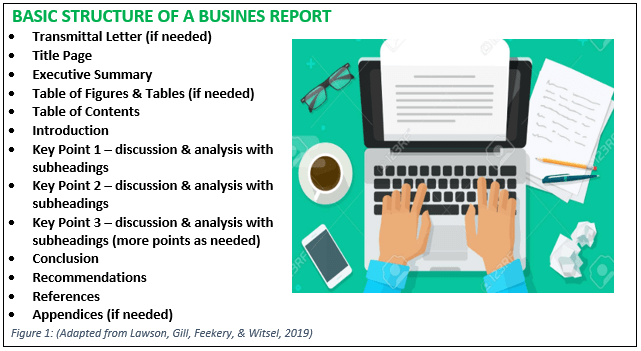
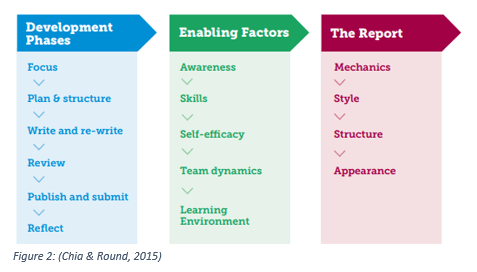
There are various key steps which are necessary in the process of producing an effective business report. Figure 1 shows a basic report structure which can be adapted and modified as required and can vary in length. Other structures can also be adopted so long as they are from valid academic sources.

Business reports are important writing tools in the business world, used essentially to communicate detailed information. They are highly informative and very useful for decision-making, presenting critical analysis and evaluation regarding a particular issue (Lawson, Gill, Feekery, & Witsel, 2019). Before commencing writing, it is important to understand the purpose of the report and the audience, ensuring a targeted and clear piece of writing which is written in the third person and within a specified word count (Jena, 2017). It is likely that this requires some initial research and planning.

All business reports require a title page to create an appealing first impression for the reader, presenting key information such as the title, author and date. An executive summary is written for the busy executive and is essential, providing a clear and concise summary of the purpose of the report, its key findings and any major recommendations. Furthermore, the table of contents and table of figures and tables follow the executive summary, sits on their own pages and their purpose is to provide the reader with an outline of sections of the report.

The introduction is important as it summarises the focus issue, provides any background information and describes the scope and purpose of the report. The body is the next section of the report which is the largest and provides the full analysis which is split into various logical sections through appropriate headings and sub-headings (Kaul, 2014). Moreover, the conclusion and recommendations provides a clear summary of the report and offers specific steps and solutions for the business to address any current issues (Chia & Round, 2015).

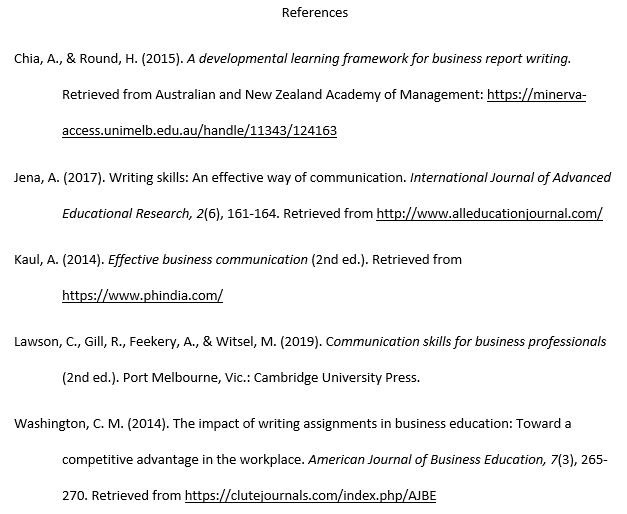
To demonstrate further evidence, it is vital that the report acknowledge all sources used, both in-text and in the reference list. Additionally, certain information can be presented as images, graphs and tables to enhance the report and can be included in the body or as appendices. Lastly, effective drafting, proofreading and formatting of the report is crucial to demonstrate professionalism, consistency and validity (Washington, 2014).

The Importance of Ethical Communication

By Taitianna McGrath (Task 4)

Lawson, Gill, Feekery and Witsel (2019, p. 119) assert that ‘ethical communication and persuasion involve informing, not tricking, the receiver so that they can make decisions based on sound logical argument.’ Ethical communication maintains the focus on the greater good and on the best interest of the receiver (Lawson et al., 2019). Ethical communication is essential through all forms of professional communication, ranging from communication within the workplace, communicating with clients, business to business communication and through advertisements and political campaigns (Neher & Sandin, 2017). It is crucial that the communicator upholds strong moral codes, is fair, accurate and diligent when communicating a message in any setting, ensuring to not deliberately or inadvertently lie, omit or distort the truth for personal gain (Mikkelsen, 2017). For example, this is particularly relevant for advertising messages to the public. Advertisements through various channels are utilised to persuade the receiver to buy, use or engage with the organisation’s products or services. Truth and transparency in advertising is critical as it would be unethical to present false information in an effort to influence the receiver’s decision-making (Australian Competition & Consumer Commission, 2020). Not only is it unethical, but false advertising is also illegal under the Competition and Consumer Act 2010 (Cth) which intends to protect consumers.

Professional communication should only present facts and legitimate figures and data which does not embellish the truth to present a better case to the receiver. Messages containing misleading, false or deceptive information would be considered tricking the receiver as they would have a false foundation to make decisions (Toledano, 2018; Lawson et al., 2019). Furthermore, publicly posted messages by businesses or stories through news outlets today can reach millions of people through the internet and social media so it is vital that they contain correct information. Ethical communication is crucial for a business when dealing with customers as it is important not to take advantage of people who do not have sufficient knowledge about a product or service. For example, when helping a customer choose a product, the salesperson must be transparent and honest. In order for the receiver to be fully informed with accurate information to make logical decisions, the message should be truthful, well researched, clear and easy to understand (Lawson et al., 2019).

Website Communication with Increasingly International and Intercultural Audiences

By Taitianna McGrath (Task 5)

Australia is a country that is rich with diversity and multiculturalism as demonstrated in figure 1 below which presents some important statistics (Australian Human Rights Commission, 2015). The Australia Bureau of Statistics (2017) further reveals that the nation is ever-expanding, with 49% of the population being first or second generation Australian and there being over 300 different languages spoken throughout Australia.

Due to this, it is vital that all Australian organisations ensure that their communication is effective in catering to our international and intercultural audiences, both locally and internationally (Lawson, Gill, Feekery, & Witsel, 2019). In today’s modern era, organisations can communicate directly to a wide-ranging audience of millions of people through online platforms, such as their websites or social media pages (Demangeot & Broderick, 2016). Tourism Australia is a government entity designed to boost tourism by attracting overseas people to the country.

Their website does meet the communication needs for an increasingly international and intercultural audience through various elements and details. The website is visually attractive as they utilise brighter colours on the home page, with themes of yellow and blue (Tigre Moura, Singh, & Chun, 2016). Furthermore, through their effective use of whitespace, easy-to-read font and larger font sizes, Tourism Australia have eliminated any noise and have ensured that their website is uncluttered, clear and simple. This, along with their clearly defined titles and subheadings, symbols and imagery, allows for easier navigation and website usability (García García, Carrillo-Durán, & Tato Jimenez, 2017).

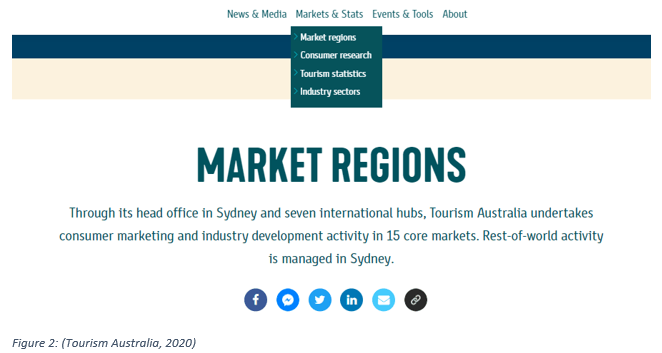
Additionally, figure 2 and 3 below provide a snapshot example of Tourism Australia’s website. The example shows the subheadings for ‘Markets & Stats’ and the webpage when you click on the subheading of ‘Market regions.’ As demonstrated, Tourism Australia’s website structure and layout is straightforward, ensuring their information is easily locatable (Cui, Wang, & Teo, 2015). The content is accurate, concise and embodies simple sentences and professional language which enhances the website’s clarity and avoids misunderstandings. Moreover, Tourism Australia has further catered to international and intercultural audiences by ensuring that the images on their home page show diverse people of different races, skin colours and backgrounds. This in turn, creates a more positive communication dynamic between the organisation and the reader.

The Unspoken Truth

By: Billy Van Moolenbroek (Task 8)

Non-verbal communication plays a vital role in successful communication as it directly affects the delivery of the message.  Non-verbal communication refers to the non-spoken elements such as body language, gestures and appearance.  Communicators need to be aware of how their non-verbal communication impacts presentations as only a small percentage of the human brain can process verbal communication.  As a result, the wrong message can be delivered if the communicator’s body language does not match the message (John, Nagarajan, & Arthi, 2017, p. 97).  For example, a business leader would not conduct a meeting while wearing a Hawaiian shirt, or slouching in their chair, as the audience will be less acceptant.  Therefore, if the speaker demonstrates effective and appropriate non-verbal communication, the audience is more likely to be receptive to the speaker’s message.  Today’s interconnected business landscape means non-verbal communication methods are a necessary skill in all working environments

Communication Coach Alex Lyon (2017) released a video on his YouTube channel explaining his three key points to non-verbal communication: Eye contact and smile, posture and gestures, and pause and nod after key ideas.  There are a variety of situations where making eye contact and smiling are necessary non-verbal elements to facilitate successful communication.  For example:

  • Eye contact is important when delivering presentations as it lets the audience know you are confidently speaking to them, not simply reading from a script which makes them more interested and engaged with the topic (Schulz, 2012).
  • Through everyday conversations with colleagues, eye contact and smiling is important as it promotes a mutual feeling of trust between both parties and can enhance the culture and team collaboration in the workplace. For example, if a person refuses to make and maintain direct eye contact, it can be seen as suspicious (Schulz, 2012).
  • For those in sale positions, maintaining proper eye contact and smiling can help the customer feel at ease and more inclined to make a purchase (Business Queensland, 2017).
  • Non-verbal communication directly affects employability as approximately 99% of employers base their hiring decisions on the applicant’s proficiency (Olszewski, Panorska, & Gillam, 2017, pp. 206-207).

Like Two Peas in a Podcast – The Effectiveness of Audio

By: Billy Van Moolenbroek (Task 9)

A podcast is a digital audio based communication format that has surged in popularity in recent times.  Unlike video-based forms of media, such as YouTube and Facebook, a podcast is entirely based on audio with no visual stimulus.  The recent surge in listenership was spurred by the prevalence of mobile technology and the convenience offered by podcasts’ online formats (Nwosu, Monnery, Reid, & Chapman, 2017). 

Audio is a very effective method of communication, but it needs to have the right formula.  The Harvard Business Review’s (HBR, 2020b) IdeaCast is a business and management advisory podcast, produced weekly featuring leading thinkers as guest speakers.  The following is a breakdown of how the podcast is an effective channel of communication.

Audience

The HBR IdeaCast’s primary audience are subscribers to the HBR website, businesspeople and students.  The podcast has the capacity to reach a wide-ranging audience through the HBR website and is available to listen to through most major podcast services (e.g. Apple iTunes and Spotify).

Message

The podcast is presented by Alison Beard, senior editor of the HBR.  Her voice is pleasant and inviting.  Her speech is well-paced and engaging.  She displays good interpersonal skills with her guests.  While some guests do not possess the same eloquence, the light-hearted tone of the dialogue and professionalism displayed  by both parties enhances the effect of the podcast.  These aspects keeps listeners captivated to ensure the key messages and information are communicated effectively without overwhelming the audience, increasing knowledge retention.

Channel

The podcast channel offers many benefits in the way of convenience:

  • Podcasts are accessible through any computer or mobile device for easy streaming.
  • Unlike radio, listeners are able to pause, rewind and fast forward and resume playback.
  • Listeners can download podcast episodes to their preferred devices for later listening when offline.
  • Podcasts are available through many online catalogues, such as Apple iTunes, Spotify, and apps (Dantas-Queiroz, Wentzel, & Quitroz, 2018).

Noise

Podcasts are freely available online, although, some providers include advertisements to generate revenue.  Some audiences may find advertisements disruptive to the listening experience.  The HBR IdeaCast does not contain any advertisements, allowing the listener to focus solely on the discussed topic.  In addition, transcripts of each episode are available online through the HBR website, further eliminating potential noise (HBR, 2020a).