
By Taitianna McGrath (Task 5)
Australia is a country that is rich with diversity and multiculturalism as demonstrated in figure 1 below which presents some important statistics (Australian Human Rights Commission, 2015). The Australia Bureau of Statistics (2017) further reveals that the nation is ever-expanding, with 49% of the population being first or second generation Australian and there being over 300 different languages spoken throughout Australia.
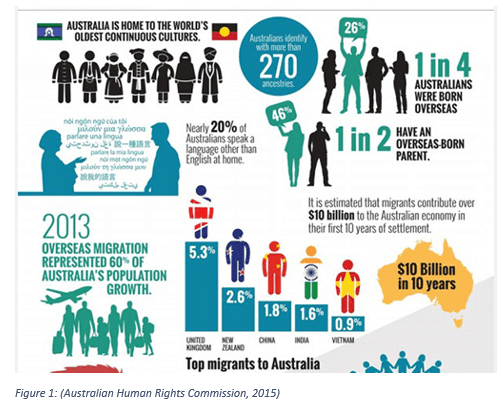
Due to this, it is vital that all Australian organisations ensure that their communication is effective in catering to our international and intercultural audiences, both locally and internationally (Lawson, Gill, Feekery, & Witsel, 2019). In today’s modern era, organisations can communicate directly to a wide-ranging audience of millions of people through online platforms, such as their websites or social media pages (Demangeot & Broderick, 2016). Tourism Australia is a government entity designed to boost tourism by attracting overseas people to the country.
Their website does meet the communication needs for an increasingly international and intercultural audience through various elements and details. The website is visually attractive as they utilise brighter colours on the home page, with themes of yellow and blue (Tigre Moura, Singh, & Chun, 2016). Furthermore, through their effective use of whitespace, easy-to-read font and larger font sizes, Tourism Australia have eliminated any noise and have ensured that their website is uncluttered, clear and simple. This, along with their clearly defined titles and subheadings, symbols and imagery, allows for easier navigation and website usability (García García, Carrillo-Durán, & Tato Jimenez, 2017).
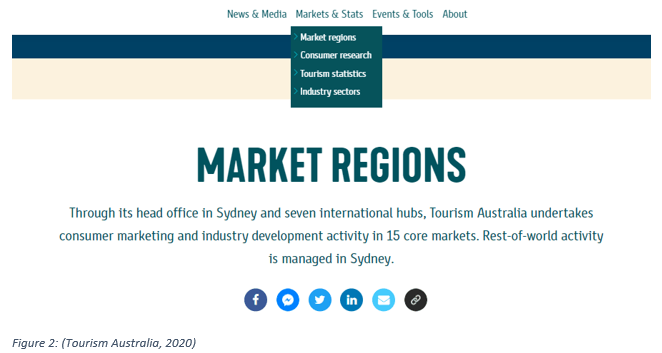
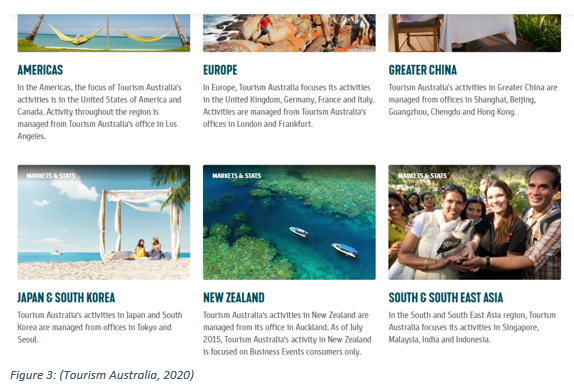
Additionally, figure 2 and 3 below provide a snapshot example of Tourism Australia’s website. The example shows the subheadings for ‘Markets & Stats’ and the webpage when you click on the subheading of ‘Market regions.’ As demonstrated, Tourism Australia’s website structure and layout is straightforward, ensuring their information is easily locatable (Cui, Wang, & Teo, 2015). The content is accurate, concise and embodies simple sentences and professional language which enhances the website’s clarity and avoids misunderstandings. Moreover, Tourism Australia has further catered to international and intercultural audiences by ensuring that the images on their home page show diverse people of different races, skin colours and backgrounds. This in turn, creates a more positive communication dynamic between the organisation and the reader.

 LOST IN COMMUNICATION